
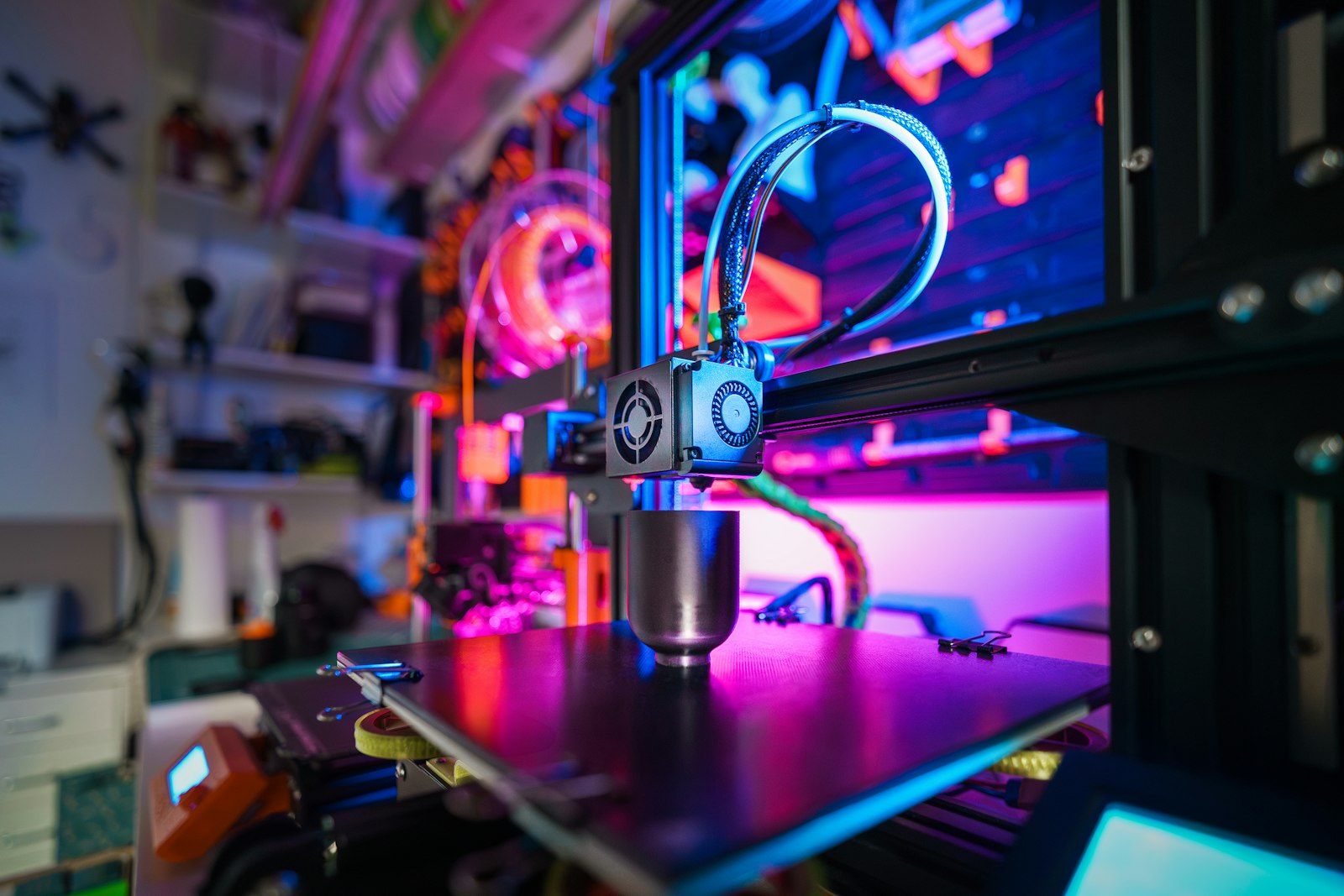
The short answer: On-demand 3D printing means nothing gets printed until somebody orders it. The buyer places an order; the seller (or a fulfillment partner) prints the product; the product ships. There is no inventory, no warehouse, no overproduction, and the seller's only commitment is the cost of the filament and the time on the printer. It is the closest thing manufacturing has to a zero-risk model.
What "on-demand" actually means
In a traditional supply chain, products are made in batches. A company forecasts demand, places an order with a factory, the factory makes 1,000 units, those units sit in a warehouse, get shipped to retailers, and eventually find buyers. The risk sits at the start of the chain: if the forecast is wrong, somebody is sitting on unsold stock.
On-demand 3D printing inverts that. Each unit is its own production run. The order arrives, the printer starts. There's no batch, no warehouse, no forecast. The seller's economic exposure is roughly equal to the cost of the filament plus the cost of running the printer — typically under €5 per item for hobby-sized prints.
How it works, step by step
- Designer uploads a model — usually an STL or 3MF file — to a marketplace.
- Buyer places an order through the marketplace.
- The order routes to a printer — either the designer's own machine or a fulfillment partner with the right material and size capability.
- The print runs, typically 1–24 hours depending on the part.
- The print is finished — supports cleaned off, lightly sanded if needed.
- The product ships directly to the buyer.
The key shift: step 3 doesn't happen until step 2 has happened. Manufacturing follows the order, not the other way around.
Why this matters: zero inventory, zero waste
For a small creator, the inventory problem is brutal. You design something cool, you guess that 50 people will want it, you print 50 units, and… 12 sell. The other 38 sit in your apartment. You've spent money on filament and weeks of print time on stock that may never move.
On-demand kills that math. You design something, you list it, and units are only printed as orders arrive. If only one person ever buys it, you print one. If 5,000 people buy it over the next year, you print as you go. The cost of being wrong is zero.
The waste angle is real too. Industry estimates suggest 30% of products manufactured under traditional supply chains are eventually thrown away unsold. With on-demand, that number is structurally close to zero — there's no batch to be unsold.
How it differs from print-on-demand for shirts
Most people first encounter "print-on-demand" via Printful, Printify, or Redbubble — services that print custom designs onto t-shirts, mugs, and posters. The model is similar (no inventory, made when ordered) but the medium is fundamentally different.
On a t-shirt, you're applying ink to a pre-existing object. The object — the shirt itself — was manufactured in a batch somewhere. With 3D printing, the entire object is created from raw filament. There's no underlying batched product.
That changes what's possible. Designs can be 3D-original (sculpted, not flat). Sizes and variations can be infinite (because each is its own print). Niche products with tiny audiences become viable — there's no minimum order quantity to clear.
The trade-offs
On-demand 3D printing is slower than batch manufacturing. A factory can produce 10,000 plastic widgets in an afternoon; a single 3D printer might take 24 hours to produce one. Per-unit cost is also higher — economies of scale don't apply when every unit is its own run.
That tradeoff is fine for the audience on-demand serves: niche designs, low volumes, customization, originals. It is not a replacement for mass manufacturing. It's a different model for a different segment of the market — the segment that's been historically underserved because traditional manufacturing's minimum-order-quantity wall is too high.
Who it's for
- Designers who want to release products without committing capital to inventory
- Niche audiences who want products that wouldn't survive a traditional supply chain — custom sizes, limited drops, made-to-order originals
- Sustainability-minded buyers who don't want to participate in overproduction
- Sellers without a warehouse — your printer is your factory
DDDIMO is built around on-demand 3D printing as the default. Print only when ordered. No inventory. No waste. Get early access.